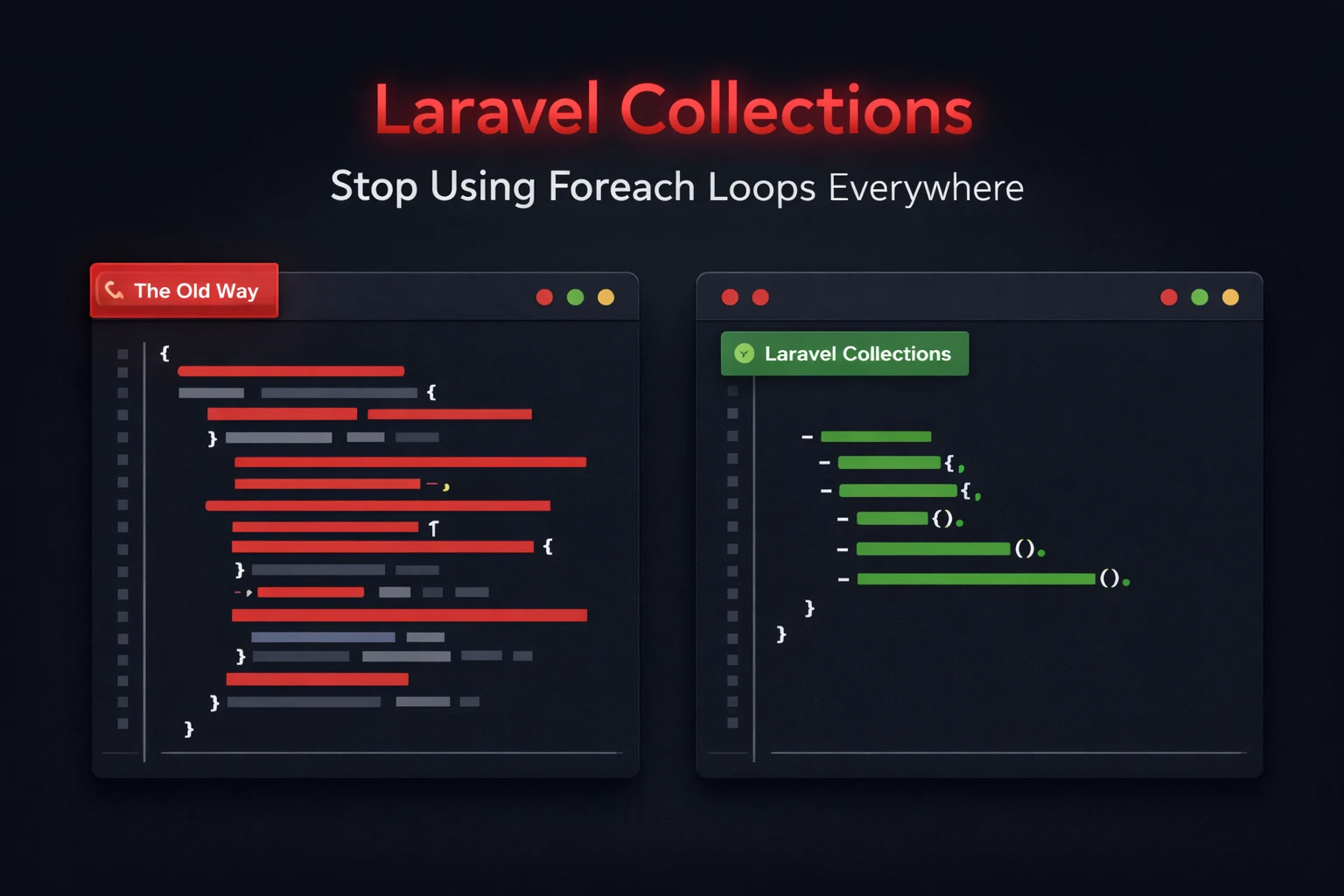
If you’ve been writing Laravel for more than a few months, you’ve probably written something like this — a 25-line foreach loop, nested inside another loop, with a bunch of if checks scattered around. It works. But three months later, even you won’t know what it does. Laravel Collections exist precisely to kill that mess. They take your plain arrays or Eloquent results and wrap them in a fluent, chainable API that reads almost like English. By the end of this article, you’ll never look at a bare foreach the same way again.
What Are Laravel Collections — And Why Should You Care?
Think of a Laravel Collection as a supercharged array. It holds your data just like an array does, but it comes loaded with over 100 methods that let you filter, sort, transform, and group that data — without writing a single loop.
Under the hood, every time you run an Eloquent query like User::all(), Laravel already returns a Collection. You’ve been using them without knowing it.
You can also create one manually from any array:
$numbers = collect([1, 2, 3, 4, 5]);That’s it. Now $numbers has access to every Collection method available. No setup, no imports — just cleaner code waiting to happen.
The Collection Methods You’ll Actually Use
Let’s get practical. Here are the five methods you’ll reach for constantly — with real before-and-after examples so you can see exactly what you’re replacing.
filter() — Ditch the If-Inside-Foreach
filter() loops through your collection and keeps only the items where your callback returns true. Everything else is dropped.
The old way:
$activeUsers = [];

foreach ($users as $user) {
    if ($user->is_active) {
        $activeUsers[] = $user;
    }
}The Collection way:
$activeUsers = $users->filter(fn($user) => $user->is_active);One line. Same result. And anyone reading your code immediately understands the intent — you’re filtering for active users. No mental parsing required.
When to use it: Any time you’re selecting a subset of items based on a condition.
map() — Transform Every Item Without a Loop
map() runs a callback on every item and returns a new collection with the transformed values. The original collection stays untouched.
The old way:
$names = [];

foreach ($users as $user) {
    $names[] = strtoupper($user->name);
}The Collection way:
$names = $users->map(fn($user) => strtoupper($user->name));You’re not mutating anything — you’re describing a transformation. That mental shift matters more than it sounds.
When to use it: When you need to reshape or transform every item in your dataset.
pluck() — Pull One Field From Every Item
This one is criminally underused. pluck() extracts a single column from your collection — no loop, no manual array building.
The old way:
$emails = [];

foreach ($users as $user) {
    $emails[] = $user->email;
}The Collection way:
$emails = $users->pluck('email');You can also pluck key-value pairs, which is incredibly useful for building dropdowns or option lists:
// Returns ['1' => 'Alice', '2' => 'Bob', ...]
$userOptions = $users->pluck('name', 'id');When to use it: Building select dropdowns, extracting IDs for a whereIn() query, or pulling any single field from a result set.
groupBy() — Organize Data Without Nested Loops
groupBy() sorts your items into groups based on a key. What used to take nested loops and temporary arrays now takes one line.
The old way:
$grouped = [];

foreach ($orders as $order) {
    $grouped[$order->status][] = $order;
}The Collection way:
$grouped = $orders->groupBy('status');

// Now you can do:
// $grouped['pending']   → all pending orders
// $grouped['completed'] → all completed orders
// $grouped['cancelled'] → all cancelled ordersThat $grouped variable is now a Collection of Collections — each group is itself a Collection, so you can keep chaining methods on it.
When to use it: Dashboards, grouped reports, categorized listings — anywhere structure matters.
chunk() — Process Data in Batches
chunk() splits your collection into smaller pieces of a given size. It’s perfect when you’re rendering grouped UI or processing data in batches.
$users = collect([1, 2, 3, 4, 5, 6, 7, 8]);

$chunks = $users->chunk(3);

// Result:
// [[1, 2, 3], [4, 5, 6], [7, 8]]In a Blade template, this pairs beautifully with a grid layout:
@foreach ($users->chunk(3) as $row)
    <div class="row">
        @foreach ($row as $user)
            <div class="col-4">{{ $user->name }}</div>
        @endforeach
    </div>
@endforeachWhen to use it: Grid layouts, batch API calls, paginating in-memory datasets.
Chaining Methods — Where the Real Magic Happens
Here’s where Collections go from “nice” to “I can’t believe I used to do this manually.”
You can chain methods together in a single, readable pipeline. Each method returns a new Collection, so the next method picks up right where the last one left off.
Let’s say you want to get the email addresses of all active users, sorted alphabetically:
The foreach nightmare:
$emails = [];

foreach ($users as $user) {
    if ($user->is_active) {
        $emails[] = $user->email;
    }
}

sort($emails);The Collection pipeline:
$emails = $users
    ->filter(fn($user) => $user->is_active)  // keep only active users
    ->pluck('email')                           // grab just the email field
    ->sort()                                   // sort alphabetically
->values(); // re-index the keys cleanlyRead that out loud. It almost sounds like a sentence. That’s the goal — code that communicates intent, not just instructions.
The .values() at the end is a small but important habit. After filter() or sort(), your collection keys can become non-sequential. values() resets them to a clean 0-indexed array.
Real-World Example: Group Orders by Status
Let’s build something you’d actually use in a real project. You have an orders page and want to display orders separated by their status — pending, completed, and cancelled — each with a count and the total value.
The messy foreach version (we’ve all written this):
$pending   = [];
$completed = [];
$cancelled = [];

foreach ($orders as $order) {
    if ($order->status === 'pending') {
        $pending[] = $order;
    } elseif ($order->status === 'completed') {
        $completed[] = $order;
    } else {
        $cancelled[] = $order;
    }
}

$pendingTotal   = 0;
$completedTotal = 0;

foreach ($pending as $order) {
    $pendingTotal += $order->amount;
}

foreach ($completed as $order) {
    $completedTotal += $order->amount;
}That’s 20+ lines and we’re not even done yet. Now try this:
The clean Collection version:
$grouped = $orders->groupBy('status');

// Get all pending orders
$pending = $grouped->get('pending', collect());

// Get total value of completed orders
$completedTotal = $grouped
    ->get('completed', collect())  // get completed group (or empty collection)
    ->sum('amount');               // sum up the amount field

// Get count of cancelled orders
$cancelledCount = $grouped
    ->get('cancelled', collect())
    ->count();

// Or do it all at once for a summary dashboard
$summary = $grouped->map(fn($group) => [
    'count' => $group->count(),
    'total' => $group->sum('amount'),
]);That last block gives you a beautiful summary array in four lines. Pass it straight to your Blade view and you’re done.
Quick Tips and Things to Watch Out For
A few things worth knowing before you start chaining everything in sight:
filter()preserves keys — after filtering, your keys might be0, 2, 5instead of0, 1, 2. Always call->values()if you need a clean re-indexed array.- Collections are in-memory — if you’re dealing with 100,000 database rows, don’t pull them all into a Collection. Use
chunk()at the query level withchunkById()instead. Collections shine on reasonably-sized datasets. collect()works on anything — you can wrap API responses, JSON-decoded arrays, even config arrays in a Collection. It’s not just for Eloquent results.- Lazy Collections exist — for genuinely large datasets, Laravel offers
LazyCollectionwhich uses PHP generators under the hood. It processes items one at a time without loading everything into memory. Worth knowing when performance matters.
Stop Writing Loops, Start Describing Intent
Here’s the mindset shift that makes this all click: a foreach loop tells PHP how to do something. A Collection chain tells your teammates what you’re trying to do. That distinction matters enormously when you’re maintaining a codebase six months from now.
Laravel Collections are one of those features that quietly make you a better developer — not because they do anything you couldn’t do before, but because they push you toward writing code that actually communicates.
So here’s the challenge: go find one foreach loop in your current project. Just one. Try rewriting it using filter(), map(), or pluck(). Chances are you’ll cut it down to a single line — and wonder why you waited this long.
Found this useful? Share it with a dev who’s still writing 30-line loops. They’ll thank you later.
Leave a Reply